
02/08/2026
Ideological and Political Context: Aesthetics vs. Action
Without a doubt, Ansel Adams could have been one of the first masters of the nature landscape photography. He’s characterized by those very simple but effective compositions that were able to net the complexity and highlight a natural subject.
Adams used the aesthetic power born from his deep technical knowledge to evoke emotion, which he then leveraged into conservation policy. He used his images to push last century’s environmental conservation. Beyond documenting untouched wilderness, he actively used art as a political tool: his 1938 book Sierra Nevada: The John Muir Trail directly influenced the U.S. Congress to establish Kings Canyon National Park. Serving on the Sierra Club’s Board of Directors for 37 years and advising presidential task forces, Adams used visual aesthetics as political lobbying, arguing that wilderness was vital to the human spirit.
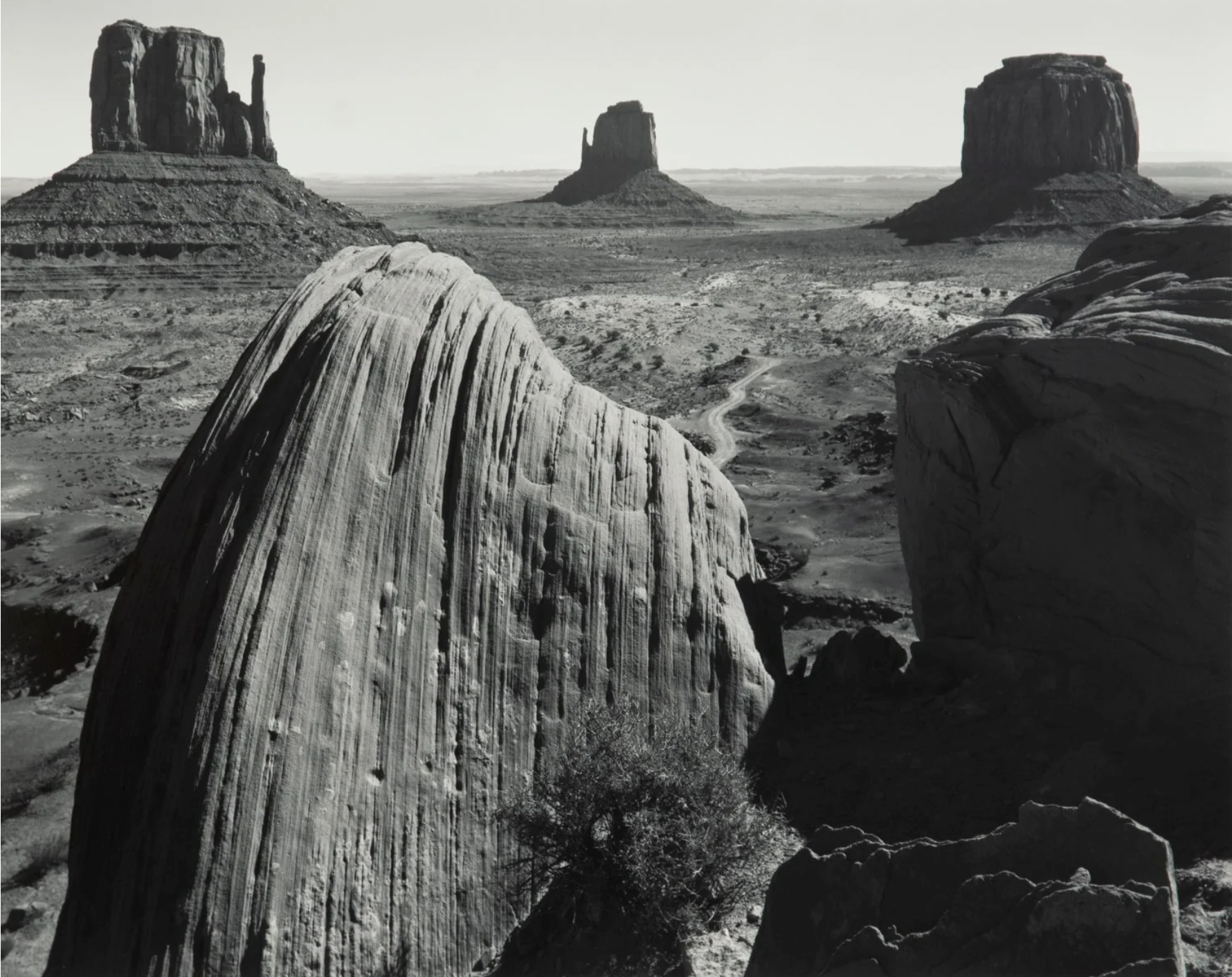
Ansel Adams, Monument Valley
Almost half a century after Adams used his camera to safeguard wilderness, a far more pervasive crisis has emerged. According to findings from the European Environment Agency (EEA) and the Copernicus Climate Change Service (C3S), Europe has become the fastest-warming continent on Earth. Average land temperatures across the Europe have already risen between 2.19°C and 2.26°C above pre-industrial levels, nearly double the global average warming rate of 1.28°C. Projections suggest temperatures could rise up to 8.5°C by the end of the century in severe scenarios. This thermal rise drives a cascading ecological crisis. During the heatwaves of 2022, Germany’s Rhine River dropped below 40 cm at the Kaub bottleneck, halting commercial shipping. Italy’s Po River experienced historic flow drops exceeding 70%, while over half of the lagoons in Spain’s UNESCO-protected Doñana National Park dried up completely. Soil moisture deficits now affect over 600,000 km² of the European Union, an area larger than France.
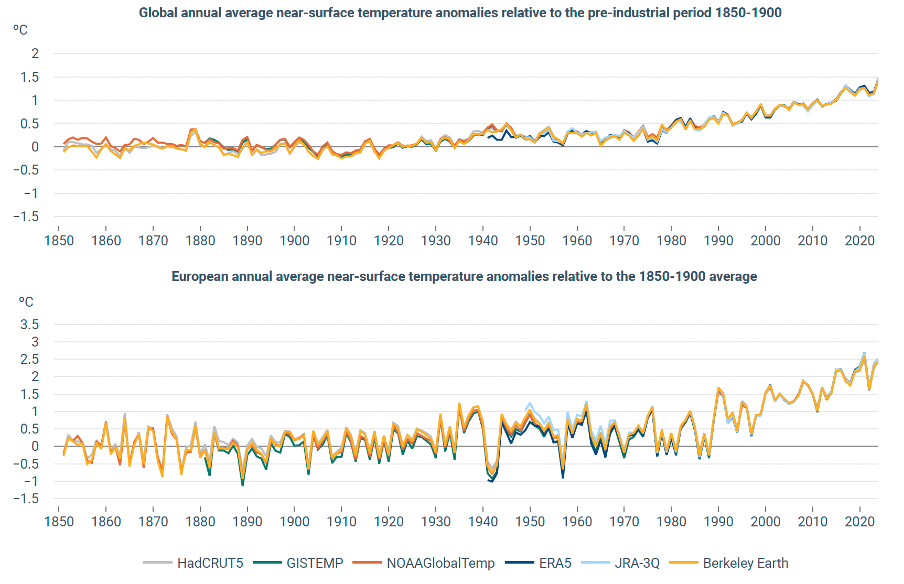
Global (above) and European (below) annual average near-surface temperature anomalies relative to the pre-industrial period 1850-1900.
European Environment Agency, Global and European temperatures, 16 June 2025
Art cannot be isolated of its historical context, and it definitely goes beyond the aesthetics. Art has exposed complex social problems and political matters. It has been a powerful means to express ideas, triggering changes, many times when other means in the hands of power had failed. Mainly because art can slip easily into people’s minds and souls.
Where Adams documented untouched wilderness to establish national parks, contemporary photographer Sebastião Salgado documented threatened Amazonian ecosystems and native communities to demand immediate protection against destruction. Salgado’s work acts as a "desperate cry" that humanizes environmental loss, proving that art must go beyond passive beauty.
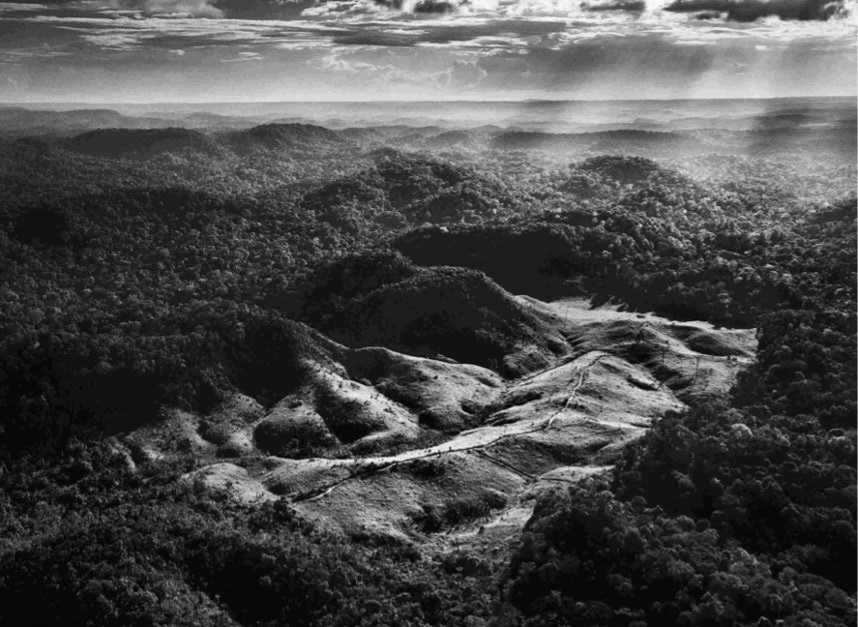
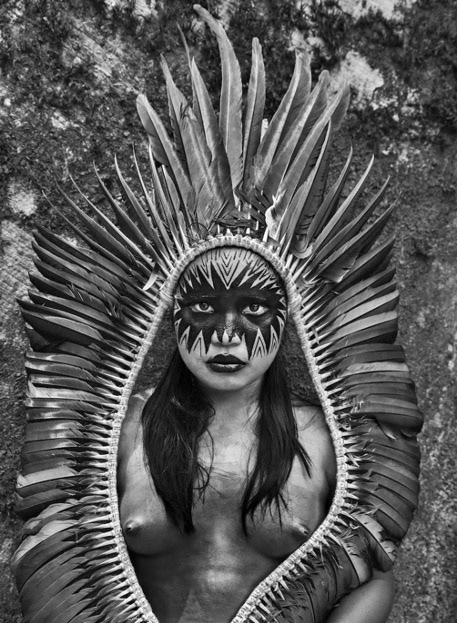
Sebastião Salgado, Amazonia
What is at stake in my own project is the necessary evolution of landscape photography. Traditional landscape art must move away from the consumer model that portraits nature as a decorative aesthetic resource. Because global warming threatens to alter these locations permanently, a change in our artistic approach is no longer optional.
Power Relations and the Infrastructure of Representation
My experimentation has taken me to use digital real-time engines to enhance technically (very) correct nature photographs. Traditional “very beautiful” water landscapes from my portfolio.
I am using Unreal Engine to restore the motion back into a still image without jeopardizing its sense of reality. To re-create the natural motion, I employ procedural noise and displacement shaders. The initial results are encouraging. I have brought to life still images by means of sophisticated real-time engine tools.
This initial step already generates some fundamental questions about control and authorship.
In traditional photography the artist maintains end-to-end control of the process. Present at the physical location, the photographer dictates composition, exposure, and color enhancement, relying entirely on personal technical skill.
By introducing digital game engines and generative AI into the pipeline, I surrender part of that control to proprietary software platforms built by massive tech corporations. These platforms rely on closed algorithms and datasets designed primarily for commercial purposes. My once standalone photograph becomes dependent on third-party rendering systems. This creates a troubling power questioning: are software conglomerates now dictating how we visualize, archive, and experience real natural ecosystems?
Ethical Paradoxes in my Practice
This experiment also introduces an ethical paradox regarding its climate footprint. While my work aims to raise awareness about global warming and environmental conservation, it relies on compute-intensive systems, high-performance real-time graphics processing, and AI models that consume significant energy. Can my artwork criticize environmental inaction while relying on heavy energy digital infrastructure?
Furthermore, the creative process itself had changed. Using tools like Adobe Photoshop and now AI generative fill, I intentionally isolate and remove the areas I want to animate, namely the water or the fog. That leaves a shocking visual void in my images! I then use code within Unreal Engine to re-inject motion and fill that void with synthetic water or fog.
I am using technology to artificially replace the natural elements that I erased. Is this an ethical concern? Maybe not. Perhaps triggering this alarm is necessary to confront viewers with a future where code becomes our only method for experiencing a flowing river.
Audience Positioning and Relational Consequences
Going from a static photograph to a dynamic, real-time environment, fundamentally changes the audience role. A photograph in a gallery is a passive experience: the viewer admires a fixed moment in time, exactly as the artist recorded it.
By animating the scene in Unreal Engine, the image becomes dynamic and responsive. It no longer constrained to a static visual record; it can react to live variables such as climate data, environmental dryness metrics, or even real-time audience presence in an exhibition space. I can simulate fictional environmental decay, such as introducing rising heat haze or wildfire effects, directly onto the artwork.
This transforms the viewer’s experience, from passive to active witness, and to internalize ecological fragility. Now the artist can challenge the audience, forcing them to confront the ongoing transformation and potential loss of the world behind the lens.
Reference Notes
1. Books
Adams, Ansel. Ansel Adams: 400 Photographs. Edited by Andrea G. Stillman. Boston: Little, Brown and Company, 2007. ISBN: 978-0-316-11772-2.
Salgado, Sebastião. Amazônia. Edited by Lélia Wanick Salgado. Cologne: TASCHEN, 2021. ISBN: 978-3-8365-8512-5.
2. Environmental & Climate Data Sources
European Environment Agency. "Global and European Temperatures." Indicators. Published June 16, 2025. https://www.eea.europa.eu/en/analysis/indicators/global-and-european-temperatures.
European Environment Agency. "Water Scarcity Conditions in Europe." Indicators. Published November 28, 2025. https://www.eea.europa.eu/en/analysis/indicators/use-of-freshwater-resources-in-europe-1.
European Space Agency. "Rhine River Runs Dry." Observing the Earth, Copernicus Sentinel-2 Data, August 16, 2022. https://www.esa.int/ESA_Multimedia/Images/2022/08/Rhine_river_runs_dry.
Montanari, Alberto, Hung Nguyen, Sara Rubinetti, Serena Ceola, Stefano Galelli, Angelo Rubino, and Davide Zanchettin. "Why the 2022 Po River Drought Is the Worst in the Past Two Centuries." Science Advances 9, no. 32 (2023): eadg8304. https://doi.org/10.1126/sciadv.adg8304.
European Commission Joint Research Centre. Drought in Europe August 2022: Report by the European Drought Observatory. JRC Technical Report. Luxembourg: Publications Office of the European Union, 2022. https://edo.jrc.ec.europa.eu/.
Green, Andy J., Carolina Guardiola-Albert, Miguel Ángel Bravo-Utrera, Javier Bustamante, Antonio Camacho, Carlos Camacho, Eva Contreras-Arribas, et al. "Groundwater Abstraction Has Caused Extensive Ecological Damage to the Doñana World Heritage Site, Spain." Wetlands 44, no. 1 (2024): 1–18. https://doi.org/10.1007/s13157-023-01769-1.